Transparency note: This post was written with the support of AI tools to help with drafting and clarity. All ideas, edits, and final wording reflect my own voice, my values and align with my therapeutic approach and professional standards.
Understanding Your Nervous System Through Polyvagal Mapping — A Pathway to Regulation, Healing & Connection
At TrueSpace Psychotherapy, I believe that healing happens when the body and mind are understood together — not treated as separate systems. So often, people come to therapy feeling confused by their own reactions: “Why do I shut down?” “Why do I get so anxious so fast?” “Why can’t I calm down even when I know I’m safe?”
Polyvagal Nervous System Mapping offers a deeply compassionate answer: your nervous system is doing exactly what it was designed to do — protect you. And once we understand how it works, we can begin to work with it rather than against it.
One powerful way to deepen that understanding is through Polyvagal Nervous System Mapping, a perspective rooted in how your nervous system senses safety, danger, connection, and calm. This work helps you explore what it feels like in your body when you’re relaxed, stressed, overwhelmed, or shut down, and learn how to support yourself toward deeper regulation, resilience, and wellbeing.
“In therapy, we don’t merely reduce symptoms — we help clients create new nervous system experiences of safety that expand their capacity for connection and choice.”
What Is the Polyvagal Nervous System Mapping?
Polyvagal mapping is a gentle, structured way of getting to know your internal world. Instead of only asking “What am I thinking?” or “What’s wrong with me?”, we begin to ask:
What state is my nervous system in right now?
What cues does my body associate with safety or threat?
How do I respond when I feel overwhelmed?
What helps me return to steadiness and connection?
Over time, mapping helps you recognize patterns and build a new relationship with your body, one that includes more understanding, more compassion, and more choice.
For many clients, this process is relieving because it replaces self-judgment with clarity. It becomes easier to say: “I’m not broken. My system is protecting me.
What Is the Polyvagal Nervous System?
Our nervous system isn’t just about “fight or flight” or “rest and digest. Polyvagal Theory, developed by neuroscientist Dr. Stephen Porges, describes how the autonomic nervous system organizes our responses to safety and threat through different physiological states that shape emotion, connection, and self-regulation (Porges, 2011). This framework describes three primary nervous system states. These aren’t personality traits or “moods.” They are biological states that shape how you feel, think, behave, and relate to others.
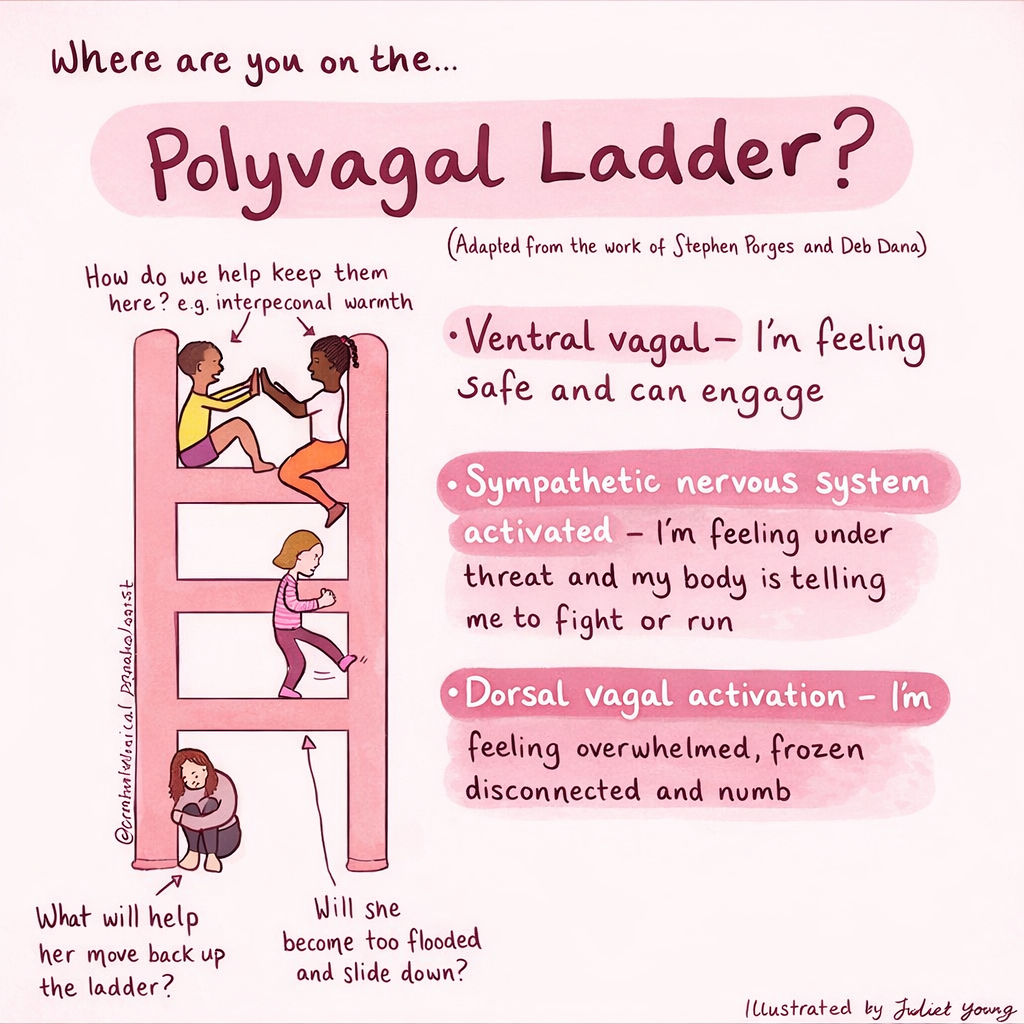
The Three Nervous System States (and What They Feel Like)
1) Ventral Vagal: Safety & Connection
This is the state we tend to associate with being “regulated.”
In ventral vagal, you may notice:
a sense of steadiness and openness
feeling more present and grounded
easier access to your emotions without being overwhelmed
more patience and flexibility
more connection to yourself and to others
This is the state where we can often reflect, communicate, repair, and feel like ourselves.
2) Sympathetic Activation: Mobilization (Fight / Flight)
This is the state of stress and survival energy. Your nervous system is preparing you to respond.
In sympathetic activation, you may notice:
anxiety, urgency, irritability, agitation
racing thoughts or spiralling
tightness in the chest, shoulders, or jaw
restlessness or feeling “wired”
difficulty sleeping or relaxing
a sense of needing to do something right now
This isn’t your body failing you — it’s your system trying to protect you through action.
3) Dorsal Vagal: Shutdown (Freeze / Collapse)
When stress becomes too much, or when your system senses that action won’t help, the nervous system may move into shutdown.
In dorsal vagal, you may notice:
numbness or emotional flatness
fatigue, heaviness, low motivation
disconnection from your body or emotions
brain fog or difficulty thinking clearly
withdrawing socially or feeling invisible
a sense of “I can’t” or “what’s the point”
Shutdown is often misunderstood as laziness or depression — but from a polyvagal lens, it can be a protective response to overwhelm.
These States Aren’t “Good” or “Bad”
These states aren’t “good” or “bad.” They are adaptive pathways your nervous system uses to help you survive and stay connected when possible (Porges, 2011; Dana, 2018). One of the most important shifts in polyvagal work is moving away from moralizing your nervous system.
You’re not “good” when you’re calm and “bad” when you’re anxious.
You’re not “weak” when you shut down.
You’re not “too much” when you feel activated.
Instead, we start to see the truth:
Your nervous system is adaptive.
It responds based on what it has learned through experience — including relationships, environment, trauma, chronic stress, and attachment history. The goal isn’t to stay calm all the time. The goal is to build flexibility, so you can move through stress and return to safety more easily.
Why We Get Stuck in Patterns (Even When We “Know Better”)
When your nervous system detects threat, it prioritizes protection over logic, which is why insight alone doesn’t always shift anxiety, shutdown, or reactivity (Porges, 2011). Many people feel frustrated because they understand their patterns intellectually, yet their body still reacts automatically.
That’s why you might:
freeze during conflict even when you want to speak up
panic when you’re trying to rest
overthink even when nothing is “wrong”
shut down emotionally in relationships you care about
feel safe one moment and overwhelmed the next
These are not character flaws. They are nervous system strategies.
Why Mapping Your Nervous System Matters
Mapping your nervous system is a way of noticing what’s happening internally — before, during, and after stress — so you can begin to understand patterns that might be keeping you stuck in old reactions. This isn’t just intellectual knowledge; it’s lived, internal awareness that becomes the foundation for meaningful change.
Once you learn to recognize your own nervous system cues, you and your therapist can work together on ways to bring your system back into states of safety and connection more often. That’s where both psychotherapy and body-based therapies become powerful partners.
A therapist trained in polyvagal-informed work can help you understand what your body is telling you, explore triggers and patterns, and build skills to regulate emotions and nervous system states more effectively. This often means shifting the focus from “thinking about change” to feeling and noticing safety in the body first.
What We Do in Polyvagal-Informed Therapy at TrueSpace Psychotherapy?
In our work together, nervous system mapping becomes both practical and deeply personal. We might explore:
your unique cues of safety (what helps you soften and settle)
your cues of threat (what triggers activation or shutdown)
the body sensations that signal a shift before your mind catches up
your “protective patterns” (over-functioning, people-pleasing, perfectionism, withdrawing, numbing, overthinking)
how your nervous system learned these responses in the first place
what helps you return to regulation in a way that feels realistic and doable
Together, we will create enough safety inside your system that calm becomes more accessible.
Regulation Isn’t a Technique — It’s a Relationship
A big misconception is that regulation is something you should be able to “do” perfectly. But regulation isn’t a performance. It’s a relationship with your body.
Often, what helps most is not pushing harder, but listening more closely:
What does my system need right now?
Is this a moment for grounding? Movement? Rest? Connection? Boundaries?
Can I offer my nervous system even a small cue of safety?
Over time, these small moments build trust. And that trust changes everything.
Who Can Benefit From Nervous System Mapping?
Polyvagal mapping can be helpful if you experience:
anxiety or panic
chronic stress or burnout
trauma responses (even if you don’t label it as trauma)
shutdown, numbness, or “going blank”
people-pleasing or difficulty setting boundaries
emotional overwhelm or sensitivity
relationship patterns that feel hard to shift
difficulty resting, sleeping, or slowing down
feeling disconnected from yourself
You don’t need to have a diagnosis to benefit from this work. You just need a nervous system and a desire to understand it more kindly.
A Gentle Beginning
If your nervous system has been living in survival mode, it makes sense that your body might feel unfamiliar, reactive, or exhausted. Polyvagal mapping offers a way to begin again, not by forcing change, but by building awareness and safety step by step. Polyvagal-informed therapy supports regulation by helping clients build awareness of nervous system shifts, strengthen cues of safety, and develop strategies that restore connection and flexibility over time (Dana, 2018).
At TrueSpace Psychotherapy, you are welcome with all of you — including the parts that feel anxious, shut down, overwhelmed, guarded, or unsure. If you’re feeling stuck in anxiety, overwhelm, or shutdown, polyvagal nervous system mapping can help you understand what your body is communicating and build practical strategies for regulation. At TrueSpace Psychotherapy, I offer polyvagal-informed, trauma- and attachment-focused therapy to support nervous system safety, resilience, and deeper connection. If you’re curious whether this approach is a fit, I invite you to book a free consultation.
References
Porges, S. W. (2011). The Polyvagal Theory. W. W. Norton.
Dana, D. (2018). The Polyvagal Theory in Therapy. W. W. Norton.
Van der Kolk, B. (2014). The Body Keeps the Score. Viking.
Ogden, P. et al. (2006). Trauma and the Body. W. W. Norton.
Polyvagal Institute. (n.d.). https://www.polyvagalinstitute.org
Dagmara Guy is a Registered Psychotherapist (Qualifying) based in Toronto and the founder of TrueSpace Psychotherapy. She is a psychodynamic and attachment-oriented therapist who explores how early relationships shape the nervous system, identity, and our capacity for connection. Her work weaves together depth psychology, trauma-informed care, and nervous system–informed approaches to support clients in moving from survival patterns toward greater regulation, self-trust, and wholeness. With a warm, relational presence and deep respect for the body’s wisdom, Dagmara helps clients gently uncover the roots beneath symptoms, making space for healing, meaning, and lasting inner change.